
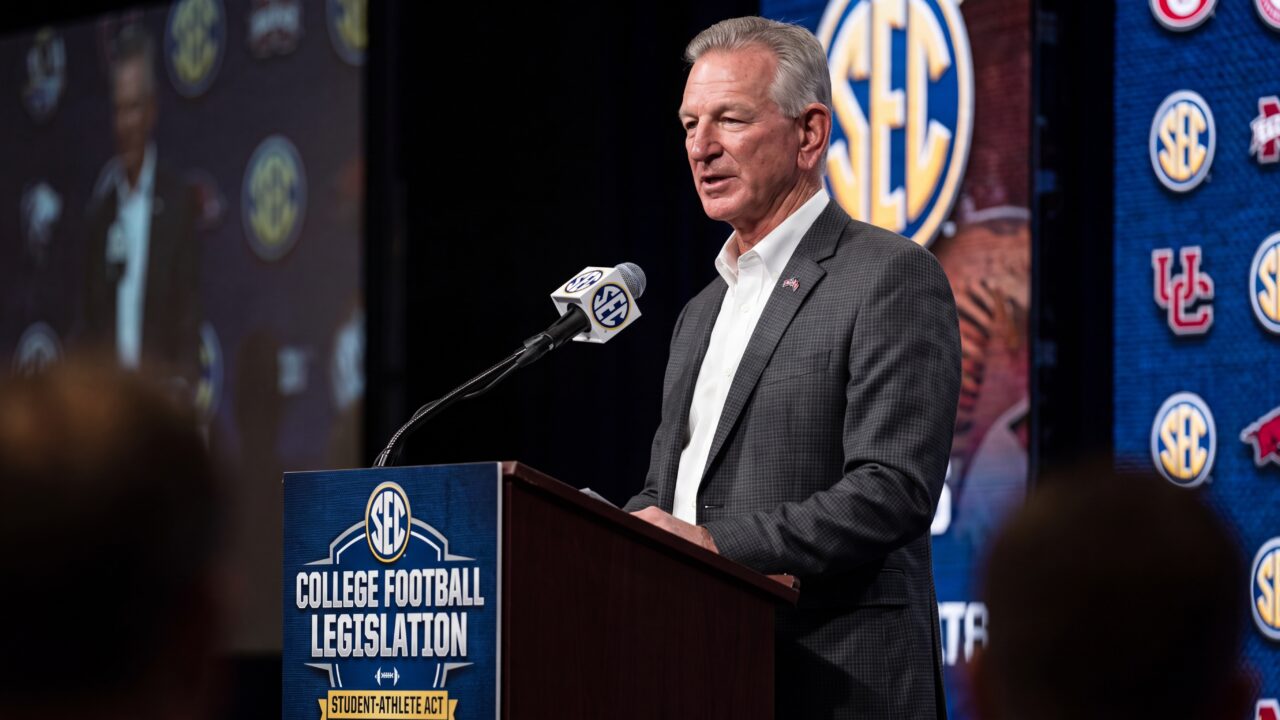
Sen. Tommy Tuberville pushed a narrow alternative to the Protect College Sports Act that could reshape eligibility and transfer rules affecting SEC roster construction and recruiting priorities.
In a memo to Republican legislative directors and in extended floor remarks, Tuberville urged GOP senators to oppose the broader bill and backed a Student-Athlete Act centered on five-year eligibility and a one-time transfer exception, as reported by Saturday Down South
Key Takeaways
- Sen. Tommy Tuberville urged GOP senators to reject the Protect College Sports Act and support a narrower Student-Athlete Act instead.
- Tuberville’s preferred alternative would narrow federal rules to five-year eligibility and a one-time transfer exception while emphasizing enforcement.
- Alabama and Auburn issued a joint statement urging lawmakers to reject the current Protect College Sports Act due to roster construction and recruiting concerns.
- Congressional decisions on these bills could require programs to adjust scholarship planning and roster timelines if enacted.
Tuberville proposal and GOP opposition
Tuberville’s proposal and floor remarks
Tuberville described the Student-Athlete Act as a narrower fix to eligibility and transfer rules compared with the broader Protect College Sports Act under consideration in Congress.
He sought unanimous consent to pass his version and emphasized limiting federal intervention to five-year eligibility windows and a one-time transfer exception while framing the change as restoring enforcement.
Alabama and Auburn pushback
Alabama and Auburn issued a joint statement urging rejection of the Protect College Sports Act in its current form and signaled institutional concern about federal mandates affecting roster construction and recruiting strategy.
The institutions flagged worries that sweeping federal rules could disrupt program management practices and established recruiting approaches at major programs.
Comparing the proposals
Supporters of the broader Protect College Sports Act present it as stabilizing college athletics through federal standards, while opponents warn it could impose uniform mandates across programs and conferences.
Tuberville framed his Student-Athlete Act as narrowly targeted at eligibility and transfers to avoid overhauling broader governance and to reestablish enforcement mechanisms.
Roster and recruiting impacts
A federal shift to five-year eligibility plus a single transfer exception would affect scholarship planning, depth management, and the timing of recruiting classes for many programs.
Programs that use multiyear redshirt strategies or frequent transfer activity would likely need to recalibrate scholarship offers and development timelines under a narrower eligibility framework.
Eligibility and enforcement comparison
| Framework | Eligibility and transfer focus | Enforcement and scope |
|---|---|---|
| Current college football practice | Eligibility and transfer rules are governed primarily by NCAA and institutional policies with varied approaches across programs and conferences | Enforcement and governance remain decentralized, handled by athletic departments and conferences |
| Protect College Sports Act (as proposed) | Offered as broader federal legislation intended to stabilize college athletics, with critics warning of wide-ranging eligibility and transfer changes | Viewed by opponents as expansive in scope and likely to impose uniform federal mandates |
| Student-Athlete Act (Tuberville proposal) | Would narrow federal intervention to five-year eligibility windows and a one-time transfer exception, per Tuberville’s memo and floor comments | Described by proponents as focused on restoring enforcement without overhauling broader governance structures |
SEC roster and College Football Playoff implications
If Congress adopts a narrower bill like Tuberville’s, SEC programs could operate under a more predictable eligibility framework that limits mid-career roster churn and better supports traditional recruiting pipelines.
Passage of a broader Protect College Sports Act could force rapid roster and scholarship-policy changes, altering short-term competitiveness and long-range College Football Playoff strategies for conference contenders such as Alabama and Auburn.
Observers should note reporting also referenced a social post from Ross Dellenger and coverage by Cory Nightingale that documented Tuberville’s memo and floor remarks, which framed the political debate around enforcement and scope.