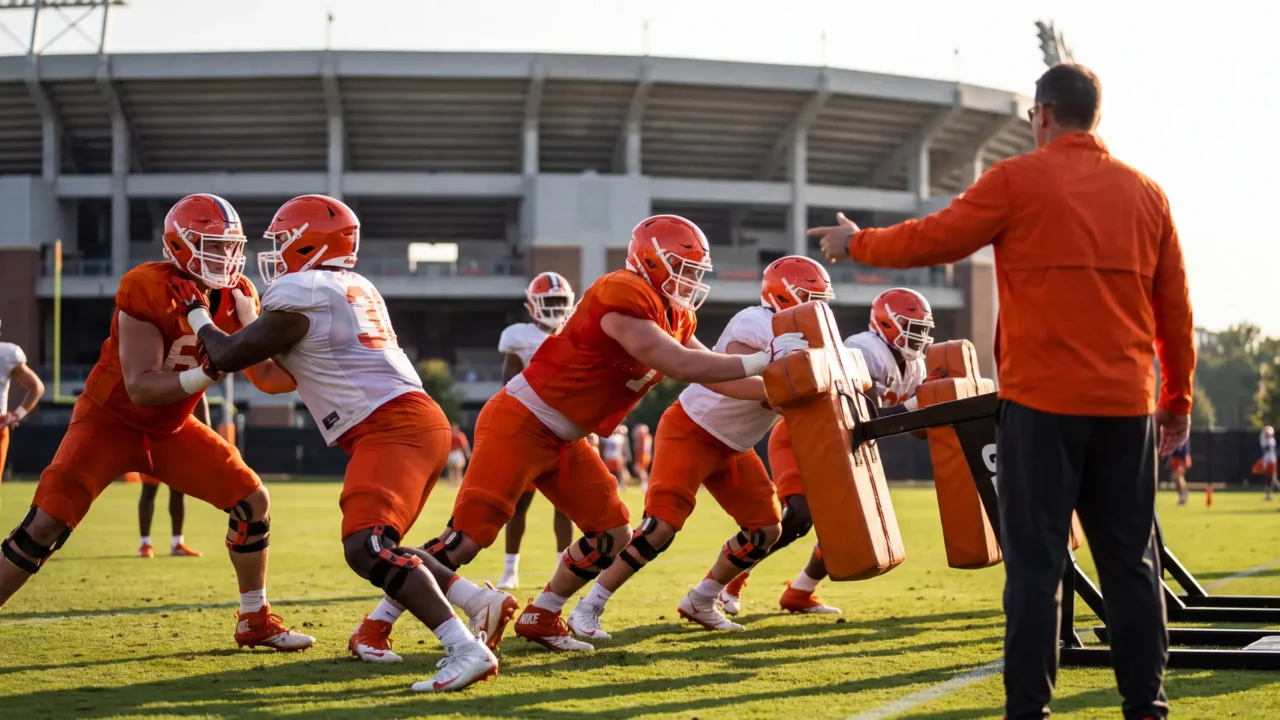
Alec Abeln opened the window on Tennessee’s tight end room after No. 18 Tennessee practiced for a second time at Haslam Field during fall training camp. The fourth-year tight ends coach emphasized physical gains from offseason work and a hunger to be coached that has shown up on the field.
Abeln spoke about the group’s progress and temperament in a session that underscored why the position could matter for the Volunteers this fall, and original reporting is available via the link below in this article for readers who want the full quotes. Vols Wire (Tennessee)
Key Takeaways
- Alec Abeln is Tennessee’s fourth-year tight ends coach and is tracking offseason development closely.
- Abeln said the tight ends have worked since January and shown physical improvement in how they move on the field.
- Abeln described the group as coachable and receptive to feedback, which he said makes his job easier.
- The team carries a No. 18 mark in the preseason US LBM Coaches Poll, which frames expectations for positional impact.
Abeln on coachability and physical progress
Abeln was direct about what he’s seeing from the tight ends after summer work: “I think physically, cannot say enough about the work those guys have done since January,” he said. That line frames the coaching staff’s view that the group’s offseason habits are translating to improved movement and readiness.
He added context on why physical gains matter beyond the weight room: “You know, it’s one thing chasing a weight, but the way it looks, the way we’re moving, really proud of the work that they’ve done so far. Excited about what it means for us this fall.” Abeln coupling visible movement with conditioning suggests the staff is focused on functional development rather than raw numbers alone.
On the topic of coachability, Abeln emphasized attitude as a performance multiplier: “It makes my job easy when the guys are wanting to be coached,” he said. That willingness to accept correction and process feedback is a tangible advantage during live install periods and position-group meetings.
How the tight ends looked on Haslam Field
No. 18 Tennessee conducted a second practice at Haslam Field during the early portion of fall camp, and the tight end group drew attention for movement and attentiveness in both drills and meetings. Abeln noted there are still areas that need attention, signaling the staff’s day-to-day checklist remains focused on fundamentals.
He was candid about in-practice learning: “Obviously, there’s things to work on. Obviously, there’s things in the meeting room, but if we can fix problems as they’re happening, even better.” That approach underscores coaching that prioritizes immediate correction during practice reps rather than deferring fixes to later evaluation.
Abeln closed his assessment by stressing the value of players who seek coaching: “You love coaching guys that are hungry for that feedback.” For Tennessee, that mindset inside the tight end room can accelerate technique work and ensure better execution once game reps begin.
Tight end group context since January
| Context | Coach assessment | Visible practice signs |
|---|---|---|
| Worked since January | Abeln credits consistent offseason effort for physical gains. | Improved movement and cleaner technique during on-field drills. |
| Coachability and development | Abeln says the group wants to be coached and is receptive to feedback. | Players respond to corrections in real time and prioritize fixing issues during reps. |
| Preseason standing context | Tennessee holds a No. 18 spot in the preseason US LBM Coaches Poll. | The tight end room’s progress factors into positional depth and matchup flexibility for the fall. |
Tight ends and Tennessee’s SEC and CFP outlook
From a roster-construction perspective, a coachable tight end corps that is moving better provides schematic flexibility against SEC opponents who vary between heavy fronts and nickel packages. Improved tight end play can influence third-down conversion rates and red-zone versatility without relying solely on outside receivers.
On recruiting and development, Abeln’s emphasis on consistent work since January sends a message to prospects that Tennessee values year-round improvement. That posture can aid retention of developmental recruits and present a clear path for younger players to earn meaningful roles.
The Volunteers enter camp with a preseason No. 18 ranking in the US LBM Coaches Poll, and positional growth at tight end will be one of several factors that determine how Tennessee stacks up against the deeper SEC rotation and midseason College Football Playoff discussions. Original reporting is available via the link above, which contains Abeln’s full remarks and practice context.