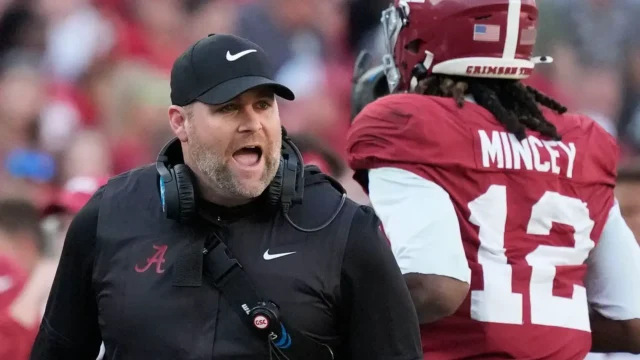

The LSU eligibility controversy now has concrete consequences for programs across the conference as the SEC moved to close what it views as a loophole for returning professionals. The conference’s action, detailed by LSU Tigers On SI, ties discipline directly to teams that sign players who have been on professional rosters.
What matters immediately is simple: the new rule changes roster calculus and coach availability, and it strips programs of a formal voice in conference business if they cross the line. That combination forces programs to weigh short-term roster gains against long-term program control and financial risk.
Key Takeaways
- The SEC approved penalties that include a half-season suspension for the head coach of the affected sport, a fine equal to 50% of that sport’s annual budget, and removal of the program’s voting rights on conference business.
- SEC commissioner Greg Sankey has authority to impose additional discipline, up to and including suspension from competition.
- LSU abstained from the conference vote, and the rule applies to players from the NFL, NBA, WNBA and affiliated professional leagues.
How the SEC rule targets returned professionals
The new policy applies broadly to athletes who have signed with, declared for, or been named on a professional roster in the NFL, NBA, WNBA or affiliated leagues. That explicit scope enlarges the enforcement net beyond football-only situations and signals the league’s intent to close cross-sport loopholes.
Penalties are structured to hit both personnel and program resources. A head coach faces a half-season suspension for the sport involved, and the program loses half of that sport’s yearly budget while also surrendering voting rights on conference matters. The financial and governance penalties are designed to be prohibitive rather than merely symbolic.
Lane Kiffin contacts and the legal backdrop
The timing of the rule traces to this summer’s legal and eligibility shifts, including the NCAA’s five-for-five eligibility rule and a Denver court decision that granted a fifth year to the class of 2022. Those changes created a narrow window of eligibility uncertainty that intersected with the portal and local court action.
When a Louisiana judge temporarily forced the college football portal to reopen for a week under a restraining order, Lane Kiffin contacted former pros who briefly re-entered the transfer window. The contacts reported in the linked account focused attention on how programs might use judicial openings to add former professionals to rosters, prompting the SEC response.
LSU eligibility controversy and what the penalties change
At the center of the conference move is LSU’s decision to abstain from the vote, a choice that underlines how high the stakes felt inside Baton Rouge. The penalties would directly affect LSU’s decision-making: signing former professionals now carries immediate coach unavailability and a material loss of operational budget and conference leverage.
That dynamic reframes any prospective roster additions. Coaches and athletic directors must now measure the short-term boost of adding a former pro against the tangible costs of diminished governance influence and reduced program funds for the season in question.
Penalty details compared with NCAA eligibility change
| Policy | Scope | Primary effects |
|---|---|---|
| SEC penalties | Players who signed with, declared for, or appeared on rosters of the NFL, NBA, WNBA or affiliated leagues | Half-season head coach suspension; fine equal to 50% of the sport’s annual budget; loss of program voting rights; commissioner can impose further discipline |
| NCAA five-for-five eligibility and court actions | Eligibility changes and a Denver court ruling affecting the class of 2022 | Expanded eligibility windows and a temporary reopening of the transfer portal in response to legal orders, creating short-term movement opportunities for affected athletes |
How penalties reshape SEC voting and LSU roster construction
Removal of voting rights on conference business is a blunt instrument that impacts a program’s ability to influence scheduling, rulemaking and revenue discussions. For a high-profile program, losing a formal seat at the table carries consequence beyond a single-season competitive hit.
On the roster side, LSU and other programs now face a strategic barrier: the calculus of adding former professionals includes the near-term loss of the head coach for half a season and a significant budget penalty. That shift will force athletic departments to consider alternatives for depth and experience rather than courting former pros whose eligibility is legally ambiguous.
The change also has ripple effects for broader SEC and CFP planning. Programs weighing late-window additions that could improve immediate competitiveness now confront governance and financial trade-offs that affect their standing across the expanded 16-team conference and their positioning for postseason access.