Texas No. 1 in ESPN FPI is more than a headline this week; it reshuffles the preseason pecking order after a dominant 59-7 season-opening win that put the Longhorns atop the predictive model. The margin, the early 28-0 burst and late-game management all fed a statistical lift that now frames Texas as the team to beat entering Week 2.
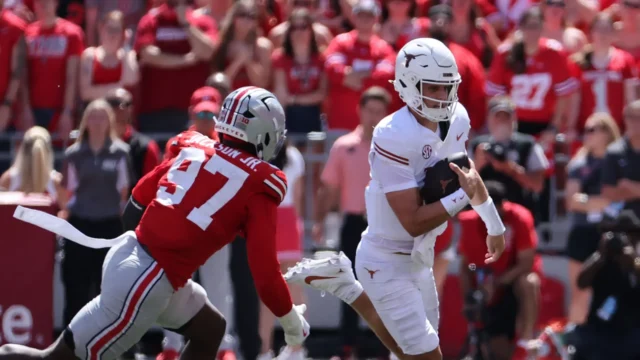
Arch Manning’s 305 yards and four touchdowns before being lifted in favor of Karle Lacey underscored both explosive top-end production and early depth signals, while Ohio State sits at No. 2 after its own 56-3 victory ahead of the Austin showdown, as reported by Saturday Down South.
Key Takeaways
- Texas moved to No. 1 in ESPN’s weekly FPI after a 59-7 season-opening win that featured a 28-0 start and 31 second-half points.
- Arch Manning threw for 305 yards and four touchdowns before being lifted late for Karle Lacey, a substitution that highlighted both dominant play and early depth evaluation.
- Five SEC teams occupy spots inside the FPI top 10, with Georgia, LSU, Alabama and Texas A&M joining Texas among the conference’s highest-rated programs.
- Texas faces a marquee Week 2 matchup with No. 2 Ohio State in Austin that will quickly test the Longhorns’ national standing.
Why Texas No. 1 in ESPN FPI matters
FPI is a weekly predictive model that reacts to margin, opponent quality and game flow rather than serving as a static poll. Texas’ lopsided opener produced a strong signal: a fast 28-0 advantage early and continued scoring that pushed the model to favor the Longhorns over previously higher-rated teams.
The practical result is a shift in expectations heading into a high-profile Week 2 meeting with Ohio State, where a win would reinforce the model’s updated position while a loss would quickly recalibrate projections. Prediction markets already reflect altered perceptions, with Texas listed at 19 percent in the market snapshot used by observers.
Arch Manning, Karle Lacey and early depth signals
Arch Manning’s stat line in the opener read like a franchise-level outing and validated the preseason hype where it mattered most: execution against a live opponent. Lifting Manning late for Karle Lacey was a standard blowout decision that also allowed a test of the backup in game conditions.
That substitution gives coaches early information on snap management, situational reps and how backups handle live pressure without compromising starters’ health. Those brief opportunities matter for roster construction as the staff sorts rotation plans and minute-management across the season.
SEC FPI ranks and market odds table
| Team | ESPN FPI Rank | Week 1 Result | Prediction Market Odds |
|---|---|---|---|
| Texas | 1 | 59-7 win vs Texas State | 19% |
| Ohio State | 2 | 56-3 win vs Ball State | Not listed |
| Georgia | 5 | Cruised past Tennessee State | 29% |
| LSU | 7 | Rout of Clemson | 16% |
| Alabama | 9 | Win over East Carolina | 9% |
| Texas A&M | 10 | 50-0 win vs Missouri State | 6% |
CFP and SEC implications
Moving to No. 1 in the FPI reshuffles projected College Football Playoff paths by changing statistical expectations for at-large slots and conference pecking order. That slot increases scrutiny on Texas’ remaining nonconference and league slate and places added emphasis on the Week 2 test in Austin.
Five SEC teams in the FPI top 10 reinforces the conference’s depth and ensures intra-conference games will carry outsized playoff implications as the season progresses. Coaches and staff will lean on those league matchups to benchmark playoff odds and inform roster priorities.