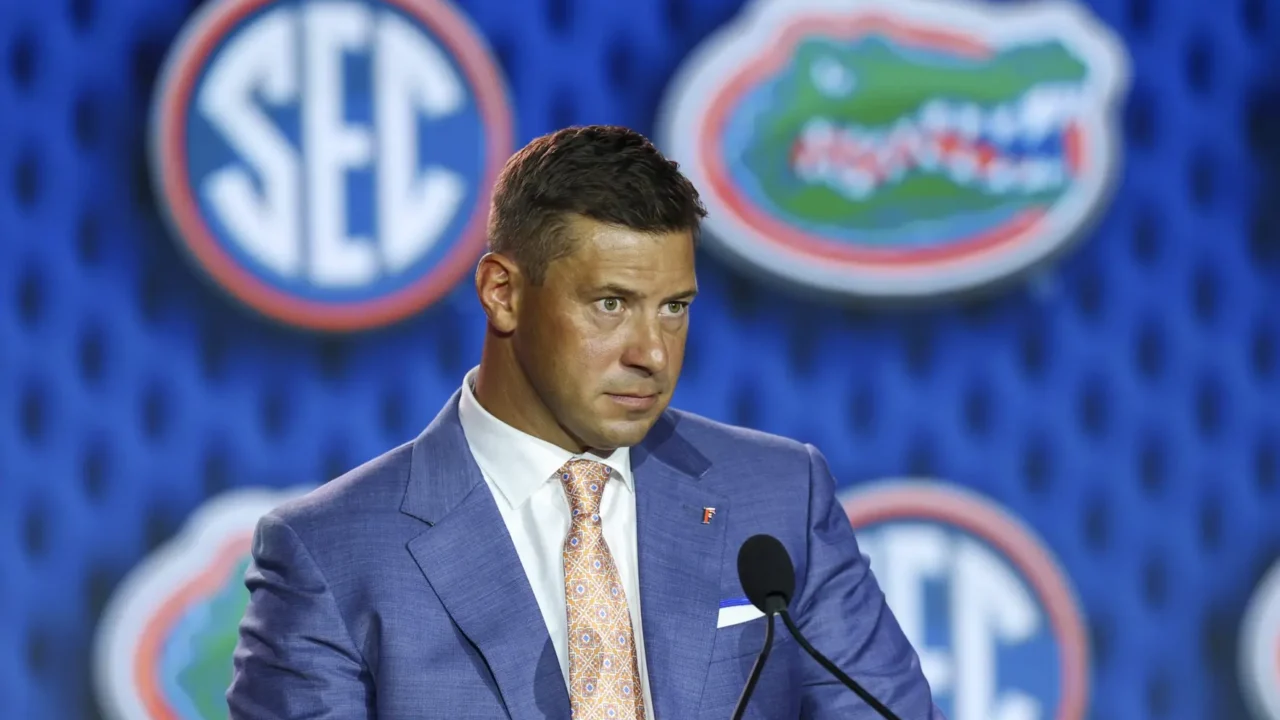
Gainesville is on edge about realistic upside for Florida Gators 2026 in Year 1 under Jon Sumrall after a roster review that landed the program inside Greg McElroy’s preseason Top 25. Local attention centers on whether schematic continuity and a crowded quarterback room can translate into wins quickly enough to change public perception.
McElroy’s breakdown, published by Saturday Down South, stresses that an unusual pairing of a play-caller and a quarterback who have already worked together could serve as a shortcut for a first-year offensive staff.
Key Takeaways
- Greg McElroy ranked Florida No. 22 in his preseason Top 25 and described the roster as better on paper than many expect.
- Continuity between the incoming offensive staff and a transfer quarterback who already worked with that staff could plausibly swing two or three games in 2026.
- Aaron Philo has not been officially named the starter and remains in competition with returning Tramell Jones for the quarterback job.
Why Greg McElroy ranks Florida Gators 2026 at No. 22
McElroy’s case is rooted in roster construction and schematic fit rather than a single breakout projection. He described the roster as strong on paper and framed his No. 22 ranking as conservative relative to the roster’s upside.
Central to McElroy’s reasoning is the offensive relationship arriving from another program and how that may reduce typical first-year friction. He noted that the quarterback and the play-caller arriving together and installing an offense they have run before is a rare advantage and could materially impact early results.
Faulkner Philo continuity and the quarterback competition
A core pillar of the projection is continuity between the new offensive staff and the incoming quarterback who previously worked with that staff. That pairing shortens installation time and reduces the usual early-season friction a first-year offense faces.
The continuity is not a guarantee of immediate production, and the quarterback spot remains unsettled. The transfer quarterback largely served as a backup at his previous stop while returning Tramell Jones, a former four-star recruit, still presents legitimate upside within the program.
On-field context and schematic fit
Even with continuity, Florida’s offense must improve from a baseline that left room for gain. Last season’s placement in the conference, 12th in SEC yards per play, is a concrete spot the staff must move upward to reach McElroy’s projected ceiling.
Improvement will depend on the speed of installation, the health and availability of key players, and how quickly either quarterback can execute the offense under live-game conditions. If the staff-shortcut works as McElroy suggests, a modest win swing could shift market perception significantly.
Historical context and market signals
| Context | Verified fact or market signal |
|---|---|
| Coaching-player continuity | Offensive coordinator and incoming transfer quarterback previously worked together at the same prior program, providing an uncommon continuity advantage for a first-year staff. |
| Market win totals | Kalshi markets show 7+ wins at 64%, 8+ wins at 39%, 9+ wins at 30%, and 10+ wins at 25%. |
SEC race and College Football Playoff paths for Florida Gators 2026
From an SEC perspective, a two- or three-game swing tied to offensive continuity would be the difference between a middle-of-the-pack league finish and a team pushing toward division contention. The SEC’s depth means every extra win has outsized value for postseason trajectory and recruiting momentum.
Market signals such as the Kalshi probabilities reflect both skepticism and latent upside. If the staff and quarterback pairing can reduce early-season growing pains, Florida could convert market complacency into tangible wins and re-enter playoff conversations before the season’s second half.