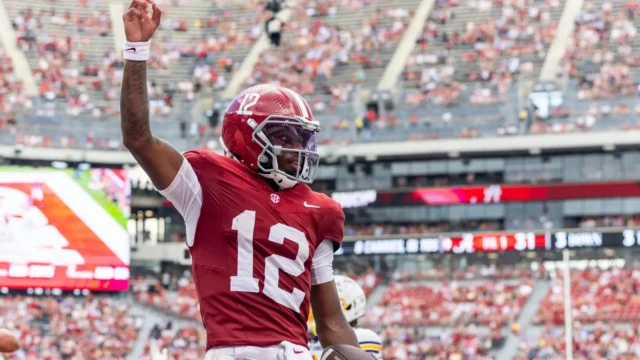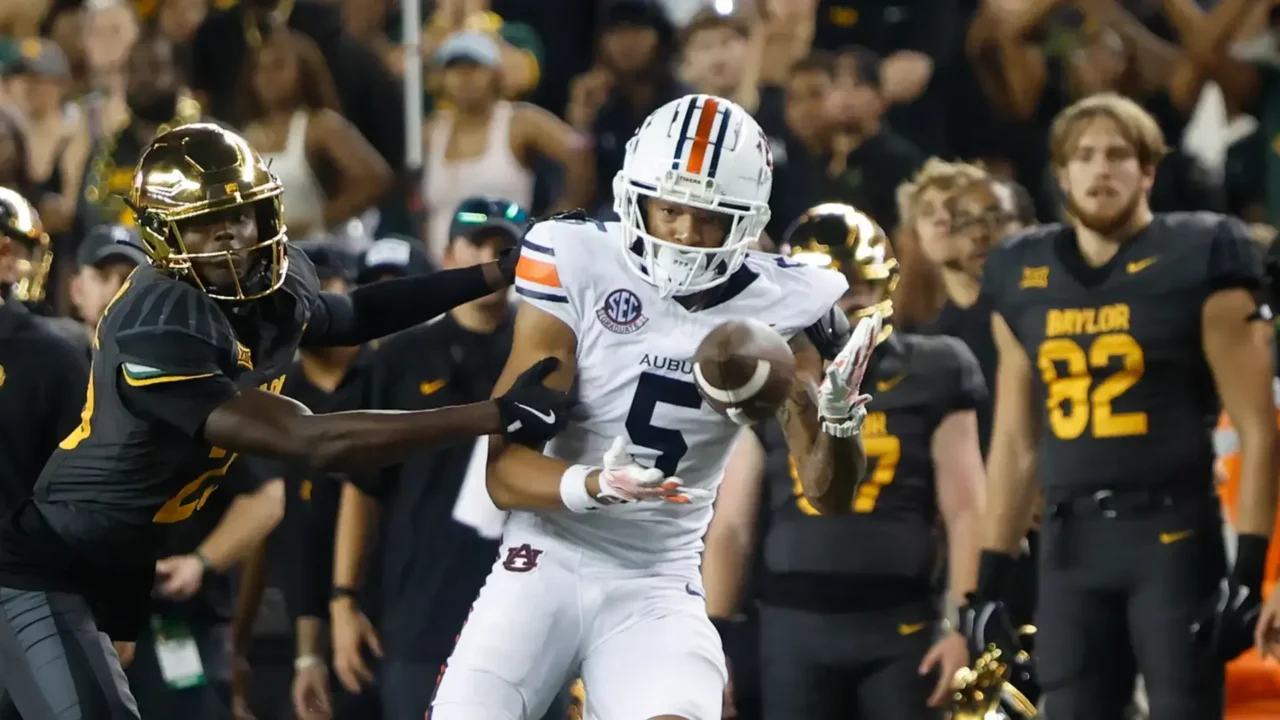
Horatio Fields has emerged as the most-talked-about camp performer in Oxford as Ole Miss rebuilds a depleted receiver room. His name has circulated among beat reporters this fall because he fits a need created by multiple departures and offers a proven short-route skill set.
Fields transferred from Auburn and brings experience and immediate upside after recording 12 receptions for 102 yards and a touchdown last season, a production profile that projects into a larger role in 2026 as the Y receiver; the original report is available on Sports Illustrated.
Key Takeaways
- Horatio Fields transferred from Auburn and recorded 12 receptions for 102 yards and one touchdown during the 2025 season.
- Ole Miss lost multiple key pass-catchers from 2025, creating an opening that Fields is positioned to fill as the Y receiver.
- Trinidad Chambliss returns as the offense’s focal point, and his quick release complements Fields’ short-route, in-traffic strengths.
How Horatio Fields fits the Ole Miss offense
Fields projects as the Y receiver in the Ole Miss scheme, a role that emphasizes short-area route work and contested catches near the sticks. His reported skill set — quick timing, ability to win in traffic, and reliable hands — matches what the position requires in this offense.
Trinidad Chambliss’ ability to get the ball out quickly plays directly to Fields’ strengths because the Y often operates on quick in-breaking routes, hitches, and targets over the middle where separation must be created with precise route timing. That connection reduces the need for long-developing plays and lets Fields produce early in the progression.
Camp praise and projected pecking order
Multiple local beat reporters have highlighted Fields during fall camp as a clear offseason winner in the receiver room. That attention reflects both his physical traits and the immediate opportunity behind several departures from last season’s group.
Deuce Alexander is projected to slot as the X receiver after a solid 2025 season, pushing Fields into the Y role and creating a complementary outside-inside pairing that Ole Miss will lean on while younger pieces develop.
Comparing returning receiver production
| Player or group | 2025 context or stat | 2026 implication |
|---|---|---|
| Horatio Fields | Transferred from Auburn; 12 receptions, 102 yards, 1 TD in 2025 | Projected Y receiver with more targets in quick game and goal-line back-shoulder calls |
| Departed receivers | Dae’Quan Wright, Cayden Lee, Winston Watkins Jr. De’Zhaun Stribling, Harrison Wallace III left the roster | Significant returning pass-catcher production lost, increasing urgency for newcomers and returning starters |
| Deuce Alexander | Returned after a solid 2025 season | Projected X receiver opposite Fields, expected to handle outside boundary and vertical responsibilities |
SEC and College Football Playoff implications
Fields stepping into a defined inside role has roster-construction consequences that ripple across the SEC schedule. Replacing multiple departures with one experienced transfer reduces immediate uncertainty at receiver and gives Ole Miss a clearer plan for passing-game personnel.
Strategically, the Rebels’ reliance on quick passing and situational back-shoulder throws makes Fields’ skill set valuable in red-zone and short-yardage moments. If Fields can reliably execute those assignments, it preserves offensive continuity and helps maintain Ole Miss’ ability to compete in a tougher SEC cycle.
From a College Football Playoff angle, stable production from the receiver room is a prerequisite for sustaining national relevance. Fields’ emergence does not erase other roster questions, but it lessens the immediate drop-off in pass-catcher experience and gives the coaching staff a veteran option as they blend younger pieces into the rotation.