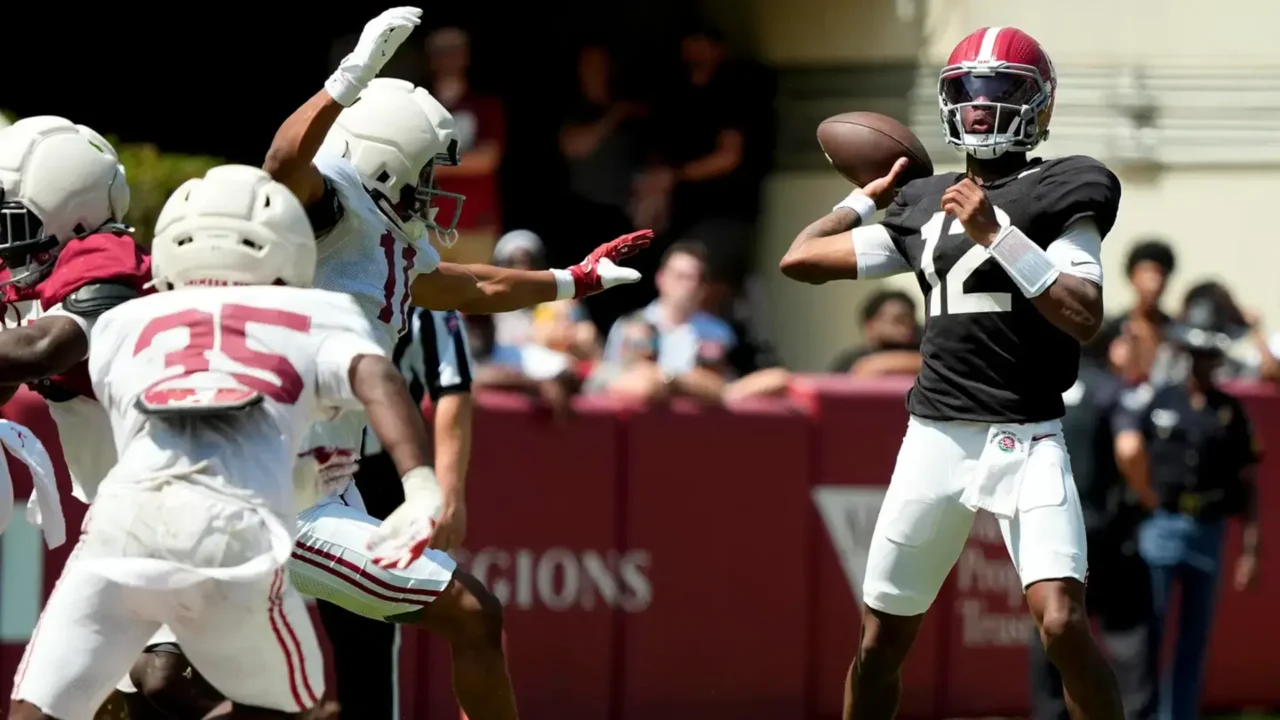
Keelon Russell (pronounced KEElin) arrives in Tuscaloosa carrying high expectations and a recruiting pedigree that shifts Alabama’s immediate ceiling among SEC contenders.
As laid out in a recent column by Bama Hammer, two bold predictions for the Tide hinge on Russell staying healthy and Alabama solving its offensive-line consistency.
Key Takeaways
- Bold Prediction No. 1: If Keelon Russell avoids missed games and key-snap injuries, Alabama projects to be a College Football Playoff team.
- Bold Prediction No. 2: If the Tide limit season-ending losses to starters and maintain a competent offensive line with Russell healthy, Alabama could reach the National Championship Game.
- Both predictions are explicitly conditional on health and offensive-line play and emphasize the learning curve against top SEC defenses.
- Coaching, protection, and roster depth are named as decisive structural elements that will determine whether recruiting pedigree converts into wins.
Why Keelon Russell changes Alabama outlook
Russell’s arrival alters Alabama’s baseline expectation because his recruiting profile places him among the most highly regarded quarterback prospects to join the program under recent evaluation methods.
That recruiting rank invites direct comparison to Bryce Young in real-time conversation around the program, and the reporting frames Russell alongside Young as a recruiting benchmark for incoming quarterbacks.
Coaches and teammates will measure readiness by how quickly Russell accelerates reads, commands a pro-style playbook, and executes under pressure, all elements the reporting ties to his high-end recruitment.
Put simply, Russell’s pedigree raises the internal standard for immediate impact, which changes how the staff will allocate reps, schematic complexity, and game-planning early in the season.
What South Carolina and Georgia defenses will teach Keelon
The reporting highlights South Carolina and Georgia as early-season measurements that will force Russell through practical lessons about pocket awareness and decision-making against top-tier SEC fronts.
Those games function as stress tests that expose where a young quarterback needs polish and reveal whether the offensive line can sustain protection long enough for higher-level processing.
Injury risk is built into that testing ground, and the conditional nature of the bold predictions explicitly ties Alabama’s ceiling to Russell missing no games and avoiding key-snap injuries.
How Russell responds to early setbacks and corrective coaching will influence whether the staff leans on conservative game plans or trusts his ceiling in critical conference moments.
Recruiting rank and QB pedigree comparison table
| Player | Recruiting background | Alabama QB pedigree context |
|---|---|---|
| Keelon Russell | Ranked among the top quarterback recruits nationally by several services, making him one of the highest-rated QB prospects to join Alabama | Arrives with expectations to translate elite recruiting pedigree into early on-field impact if protected and developed correctly |
| Bryce Young | Also listed by some recruiting services as one of the highest-ranked QB recruits to ever play at Alabama, establishing a recent benchmark for elite incoming QBs | Serves as a high-water mark for how an elite recruit can immediately elevate Alabama’s offense and national standing |
Playoff path and SEC roster implications
The two bold predictions are straightforward about their conditions: health, a consistently competent offensive line, and limited season-ending starter losses are prerequisites for Alabama to re-enter College Football Playoff contention and to contend for a National Championship.
On the roster-construction side, that means Alabama must prioritize offensive-line continuity and depth in recruiting cycles and manage starter availability across a brutal SEC slate to maximize Russell’s chances to perform at peak level.
SEC positioning and College Football Playoff access will be determined as much by those structural roster elements as by raw quarterback talent, so the program’s front office and position coaches carry a simple charge: protect the QB and sustain defensive steadiness.