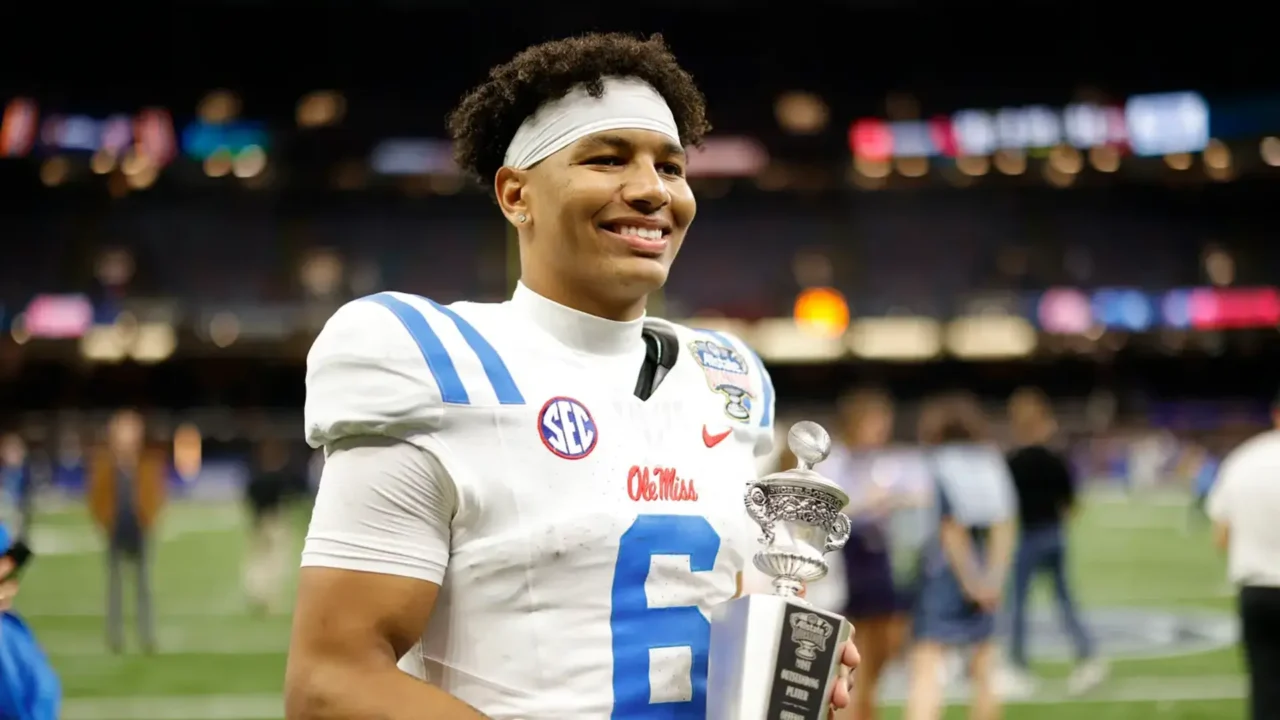
Trinidad Chambliss enters 2026 as the expected full-season starter at Ole Miss and is part of early Heisman conversations.
Last season he threw for 3,937 passing yards and combined for 30 total touchdowns despite not becoming the starter until week three, and the scale of what he can chase is clear; read the original report at Ole Miss Rebels On SI.
Key Takeaways
- Trinidad Chambliss produced 3,937 passing yards and 30 combined touchdowns last season and is expected to have a full slate of starts in 2026.
- Jaxson Dart holds the Ole Miss single-season passing mark at 4,279 yards and Chad Kelly owns the program combined-touchdown record with 41 total touchdowns, benchmarks Chambliss can chase.
- Ole Miss’s supporting cast, including running back Kewan Lacy, and the play-calling environment will directly influence Chambliss’s ability to chase those marks.
- A deep College Football Playoff run and team success would expand Chambliss’s record-setting opportunities and bolster any Heisman conversation.
Trinidad Chambliss versus Ole Miss single-season records
Chambliss faces clear program benchmarks, most notably Jaxson Dart’s single-season passing mark of 4,279 yards and Chad Kelly’s 41 combined touchdowns from 2015.
Chambliss produced 3,937 passing yards and 30 combined scores last season despite not starting until week three, so a full slate of starts shifts the projection environment toward those records.
Matching Kelly’s combined total would require additional red-zone scores or rushing touchdowns alongside sustained passing volume over a full season.
Concrete gaps to the program marks
Using the season totals already on the record, the arithmetic is simple: Chambliss needs 342 additional passing yards to equal Jaxson Dart’s 4,279-yard mark.
On combined touchdowns, Chambliss’s 30 total falls 11 shy of Chad Kelly’s 41 combined touchdowns from 2015 (31 passing, 10 rushing).
Those deficits frame what a record chase looks like on paper and clarify the margin of performance Chambliss must make up across a full slate of starts.
How modest changes translate across a season
Because Chambliss did not start until week three last season, the notion of a “full slate” matters: a small increase in yards per game and a handful of extra scoring plays can close the gaps above.
What appears numerically modest in isolation — a few dozen more yards per game or a couple of extra trips into the end zone over the season — compounds over multiple games and can be the difference between approaching those program records and surpassing them.
That dynamic explains why context around start-to-start workload and game script matters as much as pure ability.
How the roster and play callers affect Chambliss’s ceiling
The supporting cast, including running back Kewan Lacy, changes defensive focus and can create higher-per-play passing opportunities for Chambliss.
Play-calling balance and sequencing drive third-down conversions and red-zone chances that increase both yardage and touchdown totals.
Head coach Pete Golding has emphasized that individual honors often follow team success and consistent results across a season.
Supporting cast: more than individual names
A well-rounded offense shifts defensive priorities, which can open seams and create favorable matchups for a passer.
When defenses must respect a productive running game or multiple receiving threats, passing opportunities that lead to chunk plays and scoring chances become more frequent.
Those situational benefits — third-down conversions, red-zone efficiency, play-action chances — are all intrinsic to a quarterback reaching higher season totals.
Game script, sequencing and red-zone usage
Play-calling that prioritizes efficient sequencing in the red zone increases touchdown opportunities while limiting turnovers and stalled drives.
Third-down success sustains drives and multiplies offensive snaps, which in turn gives a passer more chances to pile up yards and touchdowns.
Conversely, frequently playing from behind or facing short possessions due to turnovers and special-teams issues reduces the consistency of those opportunities.
What a College Football Playoff run would change
A quarterback producing near-record numbers helps sustain drives, tilt close games, and directly affect Ole Miss’s standing in the SEC and path to the conference title game.
If Chambliss and the Rebels sustain wins and reach the College Football Playoff, extra games increase opportunities to chase records and raise national exposure that aids recruiting and NIL efforts.
Beyond the pure counting stats, playoff appearances place players on a bigger stage where national honors, award voting and media narratives become more prominent.
Counting games and exposure
More games equal more opportunities to add yards and touchdowns, and they extend the period in which voters and national audiences see a player perform at a high level.
That extended visibility can matter as much to award conversations as raw statistical totals, because voters often weigh performance in the biggest moments.
How realistic is a record chase in 2026?
Based on the numbers already in the record, the on-paper gap to both program marks is narrow enough that it is plausible under the right combination of workload and team success.
However, plausibility is not certainty: achieving those benchmarks requires consistent production across an entire season, healthy availability, and an offense that creates the play types necessary for high-yardage and high-touchdown outputs.
Because Chambliss did not start until week three in the prior season, converting projected volume from a partial to a full workload is a significant part of any projection that reaches the program records.
Variables that will determine the outcome
- Availability and health across the season for Chambliss and his key skill players.
- Offensive balance between run and pass that affects defensive priorities.
- Efficiency in the red zone and on third down, which multiplies scoring opportunities.
- Team success that produces additional games and higher-profile matchups.
What fans should watch early in the season
Early-season indicators matter more than raw totals because they reveal how the coaching staff plans to deploy the offense with Chambliss as the full-time starter.
Watch for red-zone play-calling tendencies, how often the offense leans on Kewan Lacy or other run-game options, and third-down scripts designed to sustain drives.
Those tendencies will give a clearer picture of whether the offense is structured to maximize passing volume, touchdown opportunities, or a balanced approach that protects leads and controls clock.
How this affects recruiting and roster construction
Individual production at quarterback plays into broader roster dynamics: strong passing numbers can raise a program’s profile with recruits and influence transfer-market decisions.
Team success and high-profile quarterback play also intersect with recruiting narratives, because prospective skill players often prefer systems that showcase their abilities.
Tracking how Ole Miss builds around Chambliss — for example through supplemental additions or transfer activity — will be part of the roster story in 2026.
For broader context about transfer movement that could reshape SEC rosters and impact depth charts around the conference, see Which 2026 college football transfers will dominate SEC rosters?
Stat comparison and context
| Category | Player | Single-season passing yards | Combined touchdowns |
|---|---|---|---|
| Current season baseline | Trinidad Chambliss | 3,937 | 30 |
| Program passing record | Jaxson Dart | 4,279 | — |
| Program combined-TD record | Chad Kelly (2015) | — | 41 (31 pass, 10 rush) |
Reporting details and related coverage
Story and reporting originally by Zion Trammell with photography credits to Mark J. Rebilas and Nathan Ray Seebeck.